 CSP
CSP
The Canterbury Tales is one of the greatest works in English literature, written by Geoffrey Chaucer in the late 14th century. The opening part of this famous work is known as the “General Prologue.” In this section, Chaucer introduces a group of pilgrims who are going to Canterbury to visit the shrine of Saint Thomas Becket.
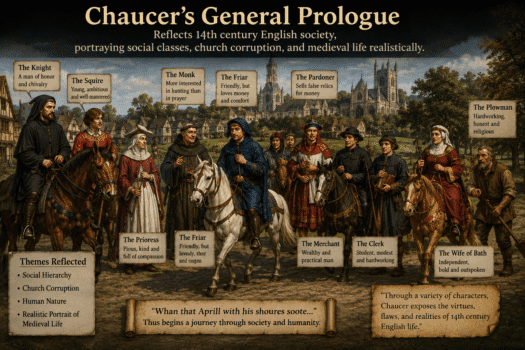
The “General Prologue” is not only an introduction to the stories but also a detailed picture of medieval English society. Chaucer presents people from different social classes, professions, and moral backgrounds. Through their dress, behavior, speech, and values, he shows the real condition of society in the 14th century. That is why many critics say that the “General Prologue” is a “mirror” of contemporary English society.
In this hand note, we will discuss how the “General Prologue” reflects the political, social, religious, and economic conditions of 14th century England.
Historical Background of the 14th Century
To understand the “General Prologue” properly, we must know about the 14th century in England. It was a time of great change and crisis.
- The Feudal System was still active. Society was divided into three main classes:
- The Nobility
- The Clergy
- The Common People
- The Black Death (1348–1350) killed nearly one-third of the population of England. This created labor shortage and social change.
- The Hundred Years’ War (1337–1453) between England and France influenced national pride and military life.
- The Rise of the Middle Class: After the Black Death, peasants demanded better wages. Merchants and traders became powerful.
- Corruption in the Church: Many church officials became greedy and immoral.
Chaucer lived in this period, so he directly experienced these social changes. In the “General Prologue,” he shows these realities clearly.
The Feudal Social Structure in the Prologue
The medieval society was divided into three “Estates”:
- Those who fight (Nobles)
- Those who pray (Clergy)
- Those who work (Common people)
Chaucer presents characters from all these three estates.
1. The Nobility: Those Who Fight
The Knight
The Knight represents the highest social class among the pilgrims. He is brave, experienced, and honorable. He fought in many wars, especially in Alexandria and other foreign lands. He follows truth, honor, generosity, and courtesy.
Through the Knight, Chaucer shows the ideal image of a medieval nobleman. He reflects the importance of chivalry in the 14th century. However, some critics say that Chaucer also shows that the age of true chivalry was slowly declining.
The Squire
The Squire is the son of the Knight. He is young, handsome, and fashionable. He loves music, poetry, and romance. Unlike his father, he is more interested in love and appearance.
Through the Squire, Chaucer shows the change in noble values. The younger generation is becoming more interested in pleasure than in honor.
The Yeoman
The Yeoman represents the lower rank of the noble class. He works as a servant to the Knight. He wears green dress and carries bow and arrows. He reflects the importance of archery in English military life.
Through these characters, Chaucer shows the military culture and feudal loyalty of medieval England.
2. The Clergy: Those Who Pray
The Church was very powerful in the 14th century. But it was also full of corruption. Chaucer presents both good and bad religious figures.
The Prioress (Madame Eglantine)
She is a nun, but she behaves like a noble lady. She speaks French badly, eats delicately, and cares more about table manners than religion. She wears a golden brooch with the words “Amor vincit omnia” (Love conquers all).
Through her, Chaucer shows that many religious people were more concerned with worldly beauty and fashion than spiritual life.
The Monk
The Monk loves hunting and fine clothes. He dislikes strict monastic rules. He owns fast horses and dresses richly.
Chaucer indirectly criticizes the corruption and luxury of monks. Instead of prayer and meditation, they enjoy comfort and pleasure.
The Friar
The Friar is even more corrupt. He takes money for forgiveness of sins. He prefers the company of rich people and avoids poor people. He is dishonest and immoral.
Through the Friar, Chaucer attacks the misuse of religion for personal profit.
The Pardoner
The Pardoner sells fake religious relics and collects money by cheating simple people. He pretends to be holy but is greedy and immoral.
The Pardoner clearly shows the corruption inside the Church.
The Parson
Unlike others, the Parson is honest and truly religious. He practices what he preaches. He helps poor people and lives a simple life. Syllabus
Through the Parson, Chaucer shows that true Christianity still existed, though rarely.
3. The Common People: Those Who Work
Chaucer gives great importance to the common people. This shows the rise of the middle class.
The Merchant
The Merchant talks about his business and profits. He hides his debts and tries to appear successful. This reflects the growing commercial class in England.
The Clerk (Student of Oxford)
The Clerk is poor but loves knowledge. He spends all his money on books. He represents the importance of education and the rise of universities.
The Lawyer (Sergeant-at-Law)
He is wise and experienced in law. But Chaucer hints that he may not be as busy as he pretends.
This shows the growing importance of law and administration.
The Franklin
He is a wealthy landowner who loves food and hospitality. He represents the comfortable rural middle class.
The Guildsmen
They are members of trade guilds. They want to become important in society. Their wives want to be called “Madam.”
This shows the rise of the urban middle class after the Black Death.
The Wife of Bath
The Wife of Bath is one of the most interesting characters. She has had five husbands. She is bold, independent, and experienced. She loves travel and talks openly about marriage.
Through her, Chaucer shows the changing role of women in society. She challenges male authority and traditional ideas.
The Miller
The Miller is strong but dishonest. He cheats people in business. He represents the rough and immoral side of rural workers.
The Reeve
The Reeve is clever and thin. He manages an estate but secretly steals money.
The Ploughman
The Ploughman is poor but honest. He works hard and lives a simple Christian life.
Through these characters, Chaucer shows the real life of ordinary people — both good and bad.
Religious Condition of the Time
The “General Prologue” strongly reflects the corruption of the medieval Church. Many church officials are greedy and immoral. They use religion for money.
However, Chaucer is balanced. He also shows good religious figures like the Parson and the Ploughman.
This shows that the 14th century Church was facing moral crisis.
Economic Condition
After the Black Death, workers demanded higher wages. Trade increased. Merchants became powerful.
The presence of:
- Merchant
- Guildsmen
- Franklin
- Shipman
shows the growing importance of business and trade.
Chaucer reflects this economic change clearly.
Social Mobility
One important feature of 14th century England was social mobility. People could change their social position.
For example:
- The Guildsmen want to rise in status.
- The Wife of Bath earns money through cloth-making.
- The Merchant hides his financial weakness.
This shows a society in transition.
Women in Society
Women usually had limited rights. But Chaucer presents different types of women:
- The Prioress (religious but fashionable)
- The Wife of Bath (independent and bold)
The Wife of Bath especially shows female power and experience. She talks confidently about marriage and authority.
Thus, Chaucer reflects the changing position of women in society.
Chaucer’s Method of Presentation
Chaucer does not directly criticize society. Instead, he uses:
- Irony
- Humor
- Realistic description
- Detailed physical portrayal
He describes dress, habits, language, and behavior. Through small details, he reveals moral character.
For example:
- The Monk’s fat body shows luxury.
- The Pardoner’s long hair suggests moral weakness.
- The Knight’s simple dress shows humility.
This realistic method makes the Prologue a true social document.
Language and Realism
Chaucer wrote in Middle English, the language of common people. Before him, Latin and French were dominant.
By writing in English, Chaucer:
- Represented national identity
- Reached ordinary people
- Reflected real life speech
His characters speak in natural ways, which adds realism.
Balance Between Ideal and Real
Chaucer does not present society as completely bad. He shows both:
Good Characters:
- Knight
- Parson
- Ploughman
Corrupt Characters:
- Friar
- Pardoner
- Monk
- Miller
This balance makes the picture realistic.
Unity of the Pilgrimage
All characters join together in a pilgrimage. This journey brings people of different classes together.
In real medieval society, classes were separate. But in the Prologue, they sit, talk, and travel together.
This shows:
- Social interaction
- Equality in spiritual journey
- Human unity
The pilgrimage becomes a symbol of life.
Critical Opinions
Many critics say that the “General Prologue” is like a picture gallery of medieval England. Each character represents a social type.
It is not only literature but also:
- A historical document
- A social commentary
- A moral observation
Chaucer is called the “Father of English Poetry” because of this great achievement.
Conclusion
In conclusion, the “General Prologue” of The Canterbury Tales is a true mirror of 14th century English society. Chaucer presents characters from every social class — noble, clergy, and common people. He shows their virtues and weaknesses.
Through detailed description, irony, and humor, Chaucer reflects:
- The feudal structure
- The corruption of the Church
- The rise of the middle class
- The economic changes after the Black Death
- The changing role of women
- The moral condition of society
He does not judge directly but lets readers understand the reality through characters.
Therefore, we can say that the “General Prologue” is not just an introduction to stories. It is a living picture of medieval England. It reflects the political, religious, social, and economic life of the 14th century.
For students, it is important to remember that Chaucer’s “General Prologue” is both a literary masterpiece and a social document. It helps us understand not only medieval England but also human nature, which remains the same in every age.
That is why the “General Prologue” is rightly called a mirror to the 14th century contemporary English society.